King James Bible Online

King James Bible Online


Search keywords in the 1611 Bible:

1611 Bible Home | Standard KJV Bible Home

Find a specific verse in the 1611 Bible:

Chapter Verse


Ecclesiastes Chapter 1  (Original 1611 KJV Bible)

>>

This is the text and a scan of the actual, original, first printing of the 1611 King James Version, the 'HE' Bible, for Ecclesiastes Chapter 1. The KJV does not get more original or authentic than this. View Ecclesiastes Chapter 1 as text-only. Click to switch to the standard King James Version of Ecclesiastes Chapter 1

Why does it have strange spelling?
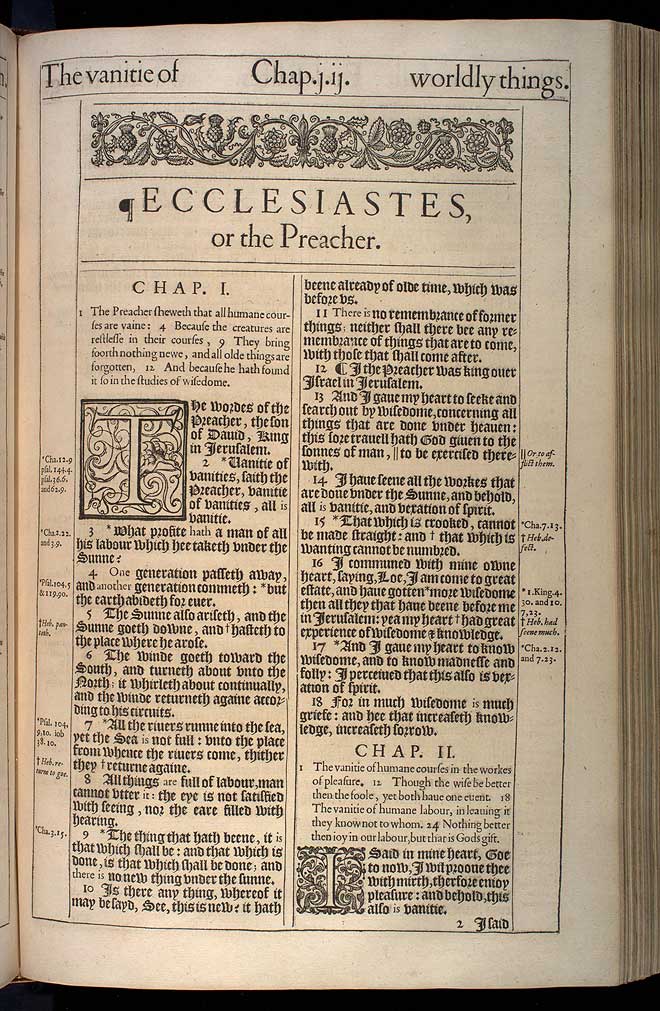

CHAP. I.

1 The Preacher sheweth that all humane courses are vaine: 4 Because the creatures are restlesse in their courses, 9 They bring foorth nothing newe, and all olde things are forgotten, 12 And because he hath found it so in the studies of wisedome.

1 The wordes of the Preacher, the son of Dauid, King in Ierusalem.

2 Uanitie of vanities, saith the Preacher, vanitie of vanities, all is vanitie.2

3 What profite hath a man of all his labour which hee taketh vnder the Sunne?3

4 One generation passeth away, and another generation commeth: but the earth abideth for euer.4

5 The Sunne also ariseth, and the Sunne goeth downe, and hasteth to the place where he arose.5

6 The winde goeth toward the South, and turneth about vnto the North; it whirleth about continually, and the winde returneth againe according to his circuits.

7 All the riuers runne into the sea, yet the Sea is not full: vnto the place from whence the riuers come, thither they returne againe.7

8 All things are full of labour, man cannot vtter it: the eye is not satisfied with seeing, nor the eare filled with hearing.

9 The thing that hath beene, it is that which shall be: and that which is done, is that which shall be done; and there is no new thing vnder the sunne.9


The vanitie of worldly things.

10 Is there any thing, whereof it may be sayd, See, this is new? it hath beene already of olde time, which was before vs.

11 There is no remembrance of former things; neither shall there bee any remembrance of things that are to come, with those that shall come after.

12 ¶ I the Preacher was king ouer Israel in Ierusalem.

13 And I gaue my heart to seeke and search out by wisedome, concerning all things that are done vnder heauen: this sore trauell hath God giuen to the sonnes of man, to be exercised therewith.13

14 I haue seene all the workes that are done vnder the Sunne, and behold, all is vanitie, and vexation of spirit.

15 That which is crooked, cannot be made straight: and that which is wanting cannot be numbred.15

16 I communed with mine owne heart, saying, Loe, I am come to great estate, and haue gotten more wisedome then all they that haue beene before me in Ierusalem: yea my heart had great experience of wisedome & knowledge.16

17 And I gaue my heart to know wisedome, and to know madnesse and folly: I perceiued that this also is vexation of spirit.17

18 For in much wisedome is much griefe: and hee that increaseth knowledge, increaseth sorrow.


View Wesley's Notes for Ecclesiastes Chapter 1


1:1 The preacher - Who was not only a king, but also a teacher of God's people: who having sinned grievously in the eyes of all the world, thought himself obliged to publish his repentance, and to give publick warning to all, to avoid those rocks upon which he had split.

1:2 Vanity - Not only vain, but vanity in the abstract, which denotes extreme vanity. Saith - Upon deep consideration and long experience, and by Divine inspiration. This verse contains the general proposition, which he intends particularly to demonstrate in the following book. All - All worldly things. Is vanity - Not in themselves for they are God's creatures and therefore good in their kinds, but in reference to that happiness, which men seek and expect to find in them. So they are unquestionably vain, because they are not what they seem to be, and perform not what they promise, but instead of that are the occasions of innumerable cares, and fears, and sorrows, and mischiefs. Nay, they are not only vanity but vanity of vanities, the vainest vanity, vanity in the highest degree. And this is redoubled, because the thing is certain, beyond all possibility of dispute.

1:3 What profit - What real and abiding benefit? None at all. All is unprofitable as to the attainment of that happiness which all men are enquiring after. His labour - Heb. his toilsome labour, both of body and mind in the pursuit of riches, or pleasures, or other earthly things. Under the sun - In all worldly matters, which are usually transacted in the day time, or by the light of the sun. By this restriction he implies that the happiness which in vain is sought for in this lower world, is really to be found in heavenly places and things.

1:4 Passeth - Men continue but for one, and that a short age, and then they leave all their possessions, and therefore they cannot be happy here, because happiness must needs be unchangeable and eternal; or else the certain knowledge of the approaching loss of all these things will rob a man of solid contentment in them. Abideth - Through all successive generations of men; and therefore man is more mutable than the very earth upon which he stands, and which, together with all the comforts which he enjoyed in it, he leaves behind to be possessed by others.

1:5 The sun - The sun is in perpetual motion, rising, setting, and rising again, and so constantly repeating its course in all succeeding days, and years, and ages; and the like he observes concerning the winds and rivers, ver.#6|,7, and the design of these similitudes seem to be; to shew the vanity of all worldly things, and that man's mind can never be satisfied with them, because there is nothing in the world but a constant repetition of the same things, which is so irksome, that the consideration thereof hath made some persons weary of their lives; and there is no new thing under the sun, as is added in the foot of the account, ver.#9|, which seems to be given us as a key to understand the meaning of the foregoing passages. And this is certain from experience that the things of this world are so narrow, and the mind of man so vast, that there must be something new to satisfy the mind; and even delightful things by too frequent repetition, are so far from yielding satisfaction, that they grow tedious and troublesome.

1:6 The wind - The wind also sometimes blows from one quarter of the world, and sometimes from another; successively returning to the same quarters in which it had formerly been.

1:7 Is not full - So as to overflow the earth. Whereby also he intimates the emptiness of mens minds, notwithstanding all the abundance of creature comforts. Rivers come - Unto the earth in general, from whence they come or flow into the sea, and to which they return by the reflux of the sea. For he seems to speak of the visible and constant motion of the waters, both to the sea and from it, and then to it again in a perpetual reciprocation.

1:8 All things - Not only the sun, and winds, and rivers, but all other creatures. Labour - They are in continual restlessness and change, never abiding in the same state. Is not satisfied - As there are many things in the world vexatious to men, so even those things which are comfortable, are not satisfactory, but men are constantly desiring some longer continuance or fuller enjoyment of them, or variety in them. The eye and ear are here put for all the senses, because these are most spiritual and refined, most curious and inquisitive, most capable of receiving satisfaction, and exercised with more ease and pleasure than the other senses.

1:9 There is - There is nothing in the world but a continued and tiresome repetition of the same things. The nature and course of the beings and affairs of the world, and the tempers of men, are the same that they ever were and shall ever be; and therefore, because no man ever yet received satisfaction from worldly things, it is vain for any person hereafter to expect it. No new thing - In the nature of things, which might give us hopes of attaining that satisfaction which hitherto things have not afforded.

1:11 No remembrance - This seems to be added to prevent the objection, There are many inventions and enjoyments unknown to former ages. To this he answers, This objection is grounded only upon our ignorance of ancient times which if we exactly knew or remembered, we should easily find parallels to all present occurrences. There are many thousands of remarkable speeches and actions done in this and the following ages which neither are, nor ever will be, put into the publick records or histories, and consequently must unavoidably be forgotten in succeeding ages; and therefore it is just and reasonable to believe the same concerning former ages.

1:12 I was king - Having asserted the vanity of all things in the general, he now comes to prove his assertion in those particulars wherein men commonly seek, and with greatest probability expect to find, true happiness. He begins with secular wisdom. And to shew how competent a judge he was of this matter, he lays down this character, That he was the preacher, which implies eminent knowledge; and a king, who therefore had all imaginable opportunities and advantages for the attainment of happiness, and particularly for the getting of wisdom, by consulting all sorts of books and men, by trying all manner of experiments; and no ordinary king, but king over Israel, God's own people, a wise and an happy people, whose king he was by God's special appointment and furnished by God, with singular wisdom for that great trust; and whose abode was in Jerusalem where were the house of God and the most wise and learned of the priests attending upon it, and the seats of justice, and colleges or assemblies of the wisest men of their nation. All these concurring in him, which rarely do in any other men, make the argument drawn from his experience more convincing.

1:13 I gave my heart - Which phrase denotes his serious and fixed purpose, and his great industry in it. To search - To seek diligently and accurately. By wisdom - By the help of that wisdom wherewith God had endowed me. Concerning - Concerning all the works of God and men in this lower world; the works of nature; the works of Divine providence; and the works and depths of human policy. This travel - This difficult and toilsome work of searching out these things, God hath inflicted as a just punishment upon man for his eating of the tree of knowledge. To be exercised - To employ themselves in the painful study of these things.

1:14 Seen - Diligently observed. Vanity - Not only unsatisfying, but also an affliction or breaking to a man's spirit.

1:15 Crooked - All our knowledge serves only to discover our miseries, but is utterly insufficient to remove them; it cannot rectify those disorders which are either in our own hearts and lives, or in the men and things of the world. Wanting - In our knowledge. Or, counted out to us from the treasures of human learning. But what is wanting, will still be so. And that which is wanting in our own knowledge, is so much that it cannot be numbered. The more we know, the more we see of our own ignorance.

1:16 Communed - I considered within myself. Great - In wisdom. Have gotten - As I had a large stock of wisdom infused into me by God, so I have greatly improved it by conversation, and study, and experience. Than all - Whether governors, or priests, or private persons. In Jerusalem - Which was then the most eminent place in the world for wisdom.

1:17 To know - That I might throughly understand the nature and difference of truth and error, of virtue and vice.

1:18 Grief - Or, displeasure within himself, and against his present condition. Sorrow - Which he does many ways, because he gets his knowledge with hard and wearisome labour, both of mind and body, with the consumption of his spirits, and shortening of his life; because he is often deceived with knowledge falsely so called, and often mistakes error for truth, and is perplexed with manifold doubts, from which ignorant men are wholly free; because he hath the clearer prospect into, and quicker sense of his own ignorance, and infirmities, and disorders, and withal how vain and ineffectual all his knowledge is for the prevention or removal of them; and because his knowledge is very imperfect and unsatisfying, yet increasing his thirst after more knowledge; lastly, because his knowledge quickly fades and dies with him, and then leaves him in no better, and possibly in a much worse condition than the meanest and most unlearned man in the world.


Ecclesiastes Chapter 1 Sidenote References (from Original 1611 KJV Bible):

2 Chap.12.9 psal.144.4. psal.36.6. and 62.9.
3 Cha.2.22. and 3.9.
4 Psal.104.5 & 119.90.
5 Heb. panteth.
7 Psal. 104. 9, 10. iob 38. 10. , Heb. returne to goe.
9 Cha. 3. 15.
13 Or, to afflict them.
15 Cha.7.13. , Heb. defect.
16 1.King.4. 30. and 10. 7, 23. , Heb. had seene much.
17 Cha.2.12. and 7.23.


* Courtesy of Rare Book and Manuscript Library, University of Pennsylvania


King James Bible


View All Ecclesiastes Chapter 1 Comments...


What Do You Think of Ecclesiastes 1?

Share your own thoughts or commentary here...


Name


Email (Will remain hidden & anonymous)


Comment: